Find Out More Information
 The Long Vision Center is located here in the central Texoma Region to help you with proper eye care. We proudly serve Sherman, McKinney, Van Alstyne, and all cities and towns in the Grayson county areas. The most common types of things our center helps with are call “Refractive errors”. You may have heard about these terms, but do you really understand what it means. If you have recently experienced some blurring of your vision then you could be at risk and we encourage you to come into the Long Vision Center and have a proper eye exam. This preventative examination will be performed by Dr. Clint Long.
What are some of the most common things you may find that could be negatively affecting your vision? They may include myopia, hyperopia, presbyopia, and astigmatism, eye conditions that are very common and don’t have any age at which they might appear. Unfortunately, most people have one or more of these conditions, and with proper diagnoses and care, these refractive errors can usually be corrected easily with eyeglasses or contact lens.
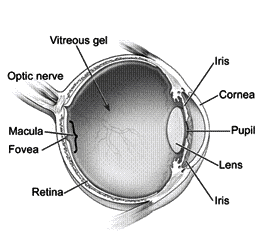
- What is myopia (nearsightedness)? – If you have myopia you can clearly see close objects, but distant objects are blurry. Myopia is caused by the eyeball being too long. Myopia occurs in different degrees from minimal to extreme. The more myopic you are the blurrier your vision is at a distance and objects will have to be closer to you so you can see them clearly.
- What is hyperopia (farsightedness)? – If you have hyperopia, you can see distant objects clearly, but close ones are blurry. Hyperopia occurs when the eyeball is too short for the light rays to focus clearly on the retina.
- What is astigmatism? – If you have an astigmatism, the surface of the eye (cornea) is not perfectly round, rather it is more oval and doesn’t allow the eye to focus clearly. The cornea is very important in helping the eye focus light rays on the retina. Astigmatism rarely occurs alone. It is usually accompanies myopia or hyperopia.
- What is presbyopia? – If you have presbyopia, you have the loss of the ability to focus up close that occurs as you age. Most people are between 40 and 50 years when they realize for the first time that they can’t read objects close to them. The letters of the phonebook are too small or you have to hold the newspaper farther away from your eye to see it clearly. At the same time your ability to focus on objects that are far way remains normal.
 Now that you know some of the basic types of refractive conditions that are common to all of us, we invite you to call the Long Vision Center and sit down with Dr. Long to discuss your particular case. Set up an eye exam and determine the best alternative you have for keeping your eyes healthy.
The information contained in this article is courtesy of The National Eye Institute. The (NEI) is part of the National Institutes of Health (NIH) and is the Federal government’s lead agency for vision research that leads to sight-saving treatments and plays a key role in reducing visual impairment and blindness. Additional information contained in this article is also courtesy of the National Eye Institute of the National Institutes of Health.